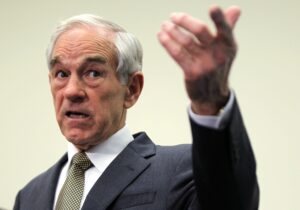
Ron Paul videos were scattered all over the web until Ron Paul Flix came along. Within minutes of being broadcast we have the Ron Paul video already listed in our catalogue. Ron Paul supporters also create many grassroots videos, and we have that list of Ron Paul videos too. Ron Paul debate video are some of our most popular videos. Ron Paul speech videos from 2007 and 2008 are being added daily. Perhaps you like Ron Paul videos on ending the Fed? Ron Paul predicted the housing crash in many videos. Whatever your preference, we hope you'll find the Ron Paul Video you're looking for here at Ron Paul Flix.

 
<< Share while you watch - video won't stop


  • Pingback: Ron Paul Appreciation Thread - Page 75 - Grasscity.com Forums

  • http://twitter.com/DejaView DejaView

    RON PAUL 2012!!!

  • Robvischer

    I love Ron Paul so much! He’s not flashy. He’s consistent.

  • http://pulse.yahoo.com/_U2TWM74HZ46GWRIGDDAZE2H3N4 George Washington

    Constitutionally, legislatively, and morally, Ron Paul has no equal. His 22 year voting record speaks for itself.
    Mr. Paul has not survived in politics for 22 years and maintain the ethics and morality he has by being anything other than stellar.
    If You refute the above comment, then I please invite You to listen to him speak about key issues. It is amazing how well he comes across because he doesn’t have to remember lies like other politicians.  He understands what is happening in the world and knows how to apply the basic principles of liberty to achieve the real change that America so desperately deserves.
    American to American we are all on the same team. So I present Mr. Ron Paul as my Candidate for 2011 and invite anybody to meaningfully and respectfully debate why he is not the best for American and its people in 2012.
    Ron Paul = A real change, not for special interest, but for America’s Interests!
    Thank You for Your time
    Ron Paul 2012

  • Pingback: Ron Paul on Faith and Prayer | LibertarianChristians.com

  • rj

    What a great defense of freedom and liberty Ron Paul gave in that debate! He carries the torch like a true hero of the Constitution, THANK YOU! You are an inspiration to us all!

  • andrew_bappe

    I weep for the future.  MSM article said Dr. Paul used terms like, “Keynesian” and “monetary policy”, therefore he’d remain a fringe candidate.  We the sheeple are too stupid to elect the right person.  If Dr. Paul is unelectable, I think I’ll just move to another country.  What a shame.

  • RP Supporter

    He annihilated the second question.  Awesome sauce.

  • Dreusky

    Ron Paul you have my vote, you are the bastion of the people.


Ron Paul CNN Debate Highlights – June 13th 2011

TRANSCRIPT:

Ron Paul: I am congressman Ron Paul. I’ve been elected to the Congress 12 times from Texas. Before I went into the Congress I delivered babies for a living and delivered 4000 babies. Now I would like to be known and defend the title that I am the Champion of Liberty and I defend the Constitution. Thank you.

John King: Congressman Paul. You’re all here saying the president of the United States is making the economy worse.  Has he done one thing — has he done one thing right when it comes to the economy in this country?

Ron Paul: Boy, that’s a tough question.

(LAUGHTER)

No, no, I can’t think of anything, but may I answer the question that you alluded to before about whether or not 5 percent is too optimistic? No, there’s nothing wrong without — without setting a goal of 5 percent or 10 percent or 15 percent, if you have a free-market economy. We’re trying to unwind a Keynesian bubble that’s been going on for 70 years, and you’re not going to touch this problem until you liquidate the bad debt and the malinvestment, go back to work.  But you have to have sound money, and you have to recognize how we got in the trouble. We got in the trouble because we had a financial bubble, and it’s caused by the Federal Reserve.  If you don’t look at monetary policy, we will continue the trend of the last decade.  We haven’t even — we haven’t developed any new jobs in the last decade.  Matter of fact, we’ve had 30 million new people and no new jobs, and it’s because they don’t — the people don’t understand monetary policy and central economic planning things.

Free markets will give you 10 percent or 15 percent growth or whatever and you will not have to turn it off because you think it’s going to cause inflation.  It doesn’t work that way.

Mike Patinsky: Well, for the candidates I’d like to know how they plan on returning manufacturing jobs to the United States .

John King:  Congressman Paul, why don’t you start with that one?

RP:  Pretty important because everything we’ve done in the last 20 or 30 years we’ve exported our jobs.  And when you have a reserve currency of the world and you abuse it, you export money.  That becomes the main export so it goes with the money. You have to invite capital. The way you get capital into a country, you have to have a strong currency, not a weak currency.  Today it’s a deliberate job of the Federal Reserve to weaken the currency.  We should invite capital back.

First thing is, we have trillions of dollars, at least over a trillion dollars of U.S. money made overseas, but it stays over there because if you bring it home, they get taxed.  If you want to, we need to get the Fed to quit printing the money and if you want capital, you have to entice those individuals to repatriate their money and take the taxes office, set up a financial system, deregulate and de-tax to invite people to go back to work again. But as long as we run a program of deliberately weakening our currency, our jobs will go overseas and that is what’s happened for a good many years, especially in the last decade.

John Distaso: Congressman Paul, this is for you. The federal government now assists many industries, green jobs, the auto industry, research and development, all get subsidies. Given the current state of the economy, what standards do you have, if any, for government assistance to private enterprise?

RP: There shouldn’t be any government assistance to private enterprise. It’s not morally correct, it’s not legal, it’s bad economics. It’s not part of the constitution. If you allow an economy to thrive, they’ll decide how R&D works or where they invest their monies. But when the politicians get in and direct things, you get the malinvestment. They do the dumb things. They might build too many houses. And they might not direct their research to the right places. So no, it’s a fallacy to think that government and politicians and bureaucrats are smart enough to manage the economy, so it shouldn’t happen.

Reveal the rest of this transcript ...

JK: So, Congressman, come into the conversation. As you do, don’t make it just about foreclosures. This is — this is an interesting topic of discussion, especially — especially when money is scarce and you’ve got to start cutting. It’s a question of priorities. What should the government be doing? And maybe what should the government be doing in a better economy that it can’t do now that has to go? So talk about foreclosures a bit, but then tell me something, if you were president and you were dealing with it in your first few weeks, and you said, “I might like to do this, but I can’t afford to do this,” be as specific as you can, what goes?

RP: Well, I would want to do much less, much sooner. The government shouldn’t be involved. You take the bankruptcies, we’ve been doing a whole lot. We’ve been propping them up. We’ve had the Federal Reserve buy all the illiquid assets, which were worthless, stick it with the taxpayers. The people who’ve made the money when the bubble was being blown up, they’re the ones who got bailed out. But you want the correction. Corrections are good. The malinvestment in the bubbles are caused by the Federal Reserve and the government, and we keep propping it up. And that’s why this is going. It was predictable it would come. It’s predictable it’s lasted three years. And it’s predictable, as long as we do what we’re doing in Washington, it’s going to last another 10 years. We’re doing what we did in the depression. We’re doing what the Japanese have done. You need to get the prices of houses down to clear the market, but they’re trying to keep the prices up. They actually have programs in Washington which stimulating housing. You need to clear the.. clear the market and then we can all go back to work. But what we’re doing now is absolutely wrong.

DR PAUL COLLINS: As a member of the Baby Boomer generation, I’ve been contributing to Medicare through payroll taxes for over 30 years. How do you propose to keep Medicare financially solvent for the next 50 years and beyond?

JK: Let’s start with Dr. Paul on this one.

RP: Well, under these conditions, it’s not solvent and won’t be solvent. You know, if you’re,  if you’re an average couple and you paid your entire amount into Medicare, you would have put $140,000 into it. And in your lifetime, you will take out more than three times that much. So a little bit of arithmetics tells you it’s not solvent, so we’re up against the wall on that. So it can’t be made solvent. It has to change. We have to have more competition in medicine. And I would think that if we don’t want to cut any of the medical benefits for children or the elderly because we have drawn so many in and got them so dependent on the government, if you want to work a transition, you have to cut a lot of money.

And that’s why I argue the case that this money ought to be cut out of foreign welfare, and foreign militarism, and corporate welfare, and the military industrial complex. Then we might have enough money to tide people over. But some revamping has to occur. What we need is competition. We need to get a chance for the people to opt out of the system. Just — you talk about opting out of Obamacare? Why can’t we opt out of the whole system and take care of ourselves?

JK: Congressman Paul, does faith have a role in these public issues, the public square, or is it a personal issue at your home and in your church?

RP: I think faith has something to do with the character of the people that represent us, and law should have a moral fiber to it and our leaders should. We shouldn’t expect us to try to change morality. You can’t teach people how to be moral. But the Constitution addresses this by saying, literally, it says no theocracy. But it doesn’t talk about church and state. The most important thing is the First Amendment. Congress shall write no laws. Which means Congress should never prohibit the expression of your Christian faith in a public place.

RP: The federal government shouldn’t be involved. I wouldn’t support an amendment. But let me suggest,  one of the ways to solve this ongoing debate about marriage, look up in the dictionary. We know what marriage is all about. But then, get the government out of it. Why doesn’t it go to the church? And why doesn’t it to go to the individuals? I don’t think government should give us a license to get married. It should be in the church.

JK: If you were president, if you become president of the United States. Now gays are allowed to serve openly in the military. Would you leave that policy in place or would you try to change, go back to don’t ask, don’t tell or something else?

RP: I would not work to overthrow it. But we have to remember, rights don’t come in groups. We shouldn’t have gay rights. Rights come as individuals. If we wouldn’t have this major debate going on, it would be behavior that would count, not the person who belongs to which group.

JK: And so, Dr. Paul, to you on this one, the question comes up, though, once they’re in the country illegally, you have compassion sometimes bumps up against enforcing the law and state budget crises. A 5-year-old child of an illegal immigrant walks into an emergency room. Does the child get care?

RP: Well, first off, we shouldn’t have the mandates. We bankrupted the hospitals and the schools in Texas and other states. We shouldn’t give them easy citizenship. We should think about protecting our borders, rather than the borders between Iraq and Afghanistan. That doesn’t make any sense to me.

(APPLAUSE)

But on coming in, you know, there was a time when government wasn’t. We didn’t depend on government for everything. There was a time when the Catholic Church actually looked after-

KING: But should they get care? Should they get care? Should taxpayers have to pay for that care?

RP: No, they should not be forced to, but we wouldn’t, we shouldn’t be penalizing the Catholic Church, because they’re trying to fulfill a role. And some of the anti-immigrants want to come down hard on the Catholic Church, and that is wrong. If we believed in our free society, as a matter of fact, this whole immigration problem is related to the economy. People aren’t coming over as much now because it’s weak. When we had a healthy economy, some of our people didn’t work and people flowed over here getting jobs. So there is an economic issue here as well.

But, no, if you have an understanding and you want to believe in freedom, freedom has solved these kind of problems before. You don’t have to say, oh, you’re not going to have care or there won’t be any care and everybody is going to starve to death and die on the streets without medical care. That’s the implication of the question. That’s just not true, and you shouldn’t accept it.

JOHN DISTASO: Here in New Hampshire there is a popular bill that is being considered by our state legislature that would restrict the state’s power to seize private land to build a power plant or a transmission facility. Should governments at any level be able to use eminent domain for major projects that will reduce America’s dependence on foreign oil?

RP: No. We shouldn’t have that power given to the government where they can take private land and transfer it to a private industry. The eminent domain laws are going to vary in different states, but we have the national eminent domain laws. It was never meant to take it from some people, private owners, and then take it and give it to a corporation because it’s going to help that locality. And this goes back to the basic understanding of property rights. Property and free society should be owned by the people, and it shouldn’t be regulated to death by the governments, whether it’s Washington, D.C., or local governments. Right now, we really don’t own our land. We just pay rent on our land and we listen to all these regulations. So I would say that courts should get out of the way, too. They should not have this right to take land from individuals to provide privileges for another group.

RP: I served five years in the military. I’ve had a little experience. I’ve spent a little time over in the Pakistan/Afghanistan area as well as Iran. But I wouldn’t wait for my generals. I’m the commander in chief. I make the decisions. I tell the generals what to do. I’d bring them home as quickly as possible. And I would get them out of Iraq as well. And I wouldn’t start a war in Libya. I’d quit bombing Yemen. And I’d quit bombing Pakistan. I’d start taking care of people here at home because we could save hundreds of billions of dollars.

Our national security is not enhanced by our presence over there. We have no purpose there. We should learn the lessons of history. The longer we’re there, the worse things are and the more danger we’re in as well because our presence there is not making friends let me tell you.

JK: Congressman Paul, if you were the president of the United States and you could pick one, but just one of these gentlemen and the lady, to join your administration, who would it be and why?

RP: Join the administration?

JK: Yes.

RP: I would think everybody would qualify.

JK: You only get to pick one. It’s about choices.

RP: I have to pick one? Hum? Let me look — let me look them over. I would have to do a bit more quizzing. I would have to — they haven’t even told me how they feel about the Federal Reserve yet. They haven’t told me about a non-intervention foreign policy. So I’ll have to do some more quizzing.

RP: I’ve learned that with a group here that disagrees on some issues, we can talk about it and be civil to each other.

Anderson Cooper: My next guest, Congressman Ron Paul, who joins us momentarily. First, by way of introduction, he drew a major following when he ran four years ago for the GOP nomination. Tonight, he drew a sharp contrast with the other candidates on military involvement abroad. Listen.

(begin video)

RP: I served five years in the military. I have had a little experience. I have spent a little time over in the Pakistan/Afghanistan area, as well as Iran. But I wouldn’t wait for my generals. I’m the commander in chief. I make the decisions. I tell the generals what to do.  And I’d bring them home as quickly as possible. And I would get them out of Iraq as well. And I wouldn’t start a war in Libya. I would quit bombing Yemen. And I would quit bombing Pakistan. I would start taking care of people here at home because we could save hundreds of billions of dollars.

Our national security is not enhanced by our presence over there. We have no purpose there. We should learn the lessons of history. And the longer we’re there, the worse things are and the more danger we’re in as well, because our presence there is not making friends, let me tell you.

(end video)

Anderson Cooper: And Congressman Paul joins me now. We just played the response you said about military serving overseas. That really does put you in stark contrast to many of the people on the stage tonight.

RP: Yeah, I think so. It did four years ago. But what I sense now…

AC: And you have been consistent all along.

RP: Yes. And what I sense now is there’s not so much of a dramatic differences. If you listen carefully, some of them are coming our way, my way, the way that I believe we should go. Where the difference is with the people, if you look at the polls and how many people think we should be in Libya and how many people think we ought to get out of Afghanistan. So, that’s where I feel completely different, although I don’t obviously have agreement, and my statement was different, because I’m rather emphatic, because I think the issue of war is so important on principle, because it’s such a deadly issue.

But it’s also a major economic issue. I look at it carefully because all great nations usually go down when they spread themselves too far around the world. They go into an empire. Then they can’t afford it, no matter how well-intentioned it is. And I know those who disagree with me are well intentioned and think this is very necessary. But, financially, it’s very, very risky. And, of course, I pointed out politically, it’s a lot easier cutting this overseas spending than it is to go after child health care. And I think that makes an important point, too.

AC: During the break, Gloria Borger sort of said to you just offhandedly, is it a sense of deja vu being back on this stage? And you said it does feel different. How does it feel different this time?

RP: Well, it felt like I was pushing much harder on the envelope before, and I was so much alone, and didn’t know what the responses were. And even in the first debate that we had in South Carolina, there was a difference. The reactions are different. And what has happened the last three years, it’s different. So, no, I think the country now is definitely moving in the direction of less government, a different foreign policy. But it’s not like it’s my foreign policy. I would sort of like to say I’m running on the position of George W. Bush’s foreign policy in the year 2000, when he talked about a humble foreign policy. People like that. But I want it, and they know it. And now it’s necessary

AC: I want to play for our viewers a response you had when you were asked about the role of faith in public life. I want to play for our viewers your response.

(begin video)

RP: I think faith has something to do with the character of the people that represent us and law should have a moral fiber to it and our leaders should. We shouldn’t expect us to try to change morality. You can’t teach people how to be moral. But the Constitution addresses this by saying literally, it says no theocracy. But it doesn’t talk about church and state. The most important thing is the First Amendment. Congress shall write no laws. Which means Congress should never prohibit the expression of your Christian faith in a public place.

(end video)

AC: The last part you said there, Congress shall never prohibit the expression or no laws which should never prohibit the expression of your Christian faith in a public space. Do you think Christianity is under attack in the United States?

RP: I think to some degree, but

AC: How so?

RP: Well, there’s certain pressures put on Christians and made fun of, you know, just subtly. I don’t think in a legislative sense. But the one point I was trying to make there is that you can’t legislate morality. And that’s what a lot of some people want to think we do. We take our morality, and we will legislate it and make you morally better people. I think that’s impossible. But I said, what has to have a moral fiber is, the law has to have a moral basis to it. And also the people who represent us should have moral character. That’s how I think our faith should influence them.

But the use of force to make people live better. See, I apply that in economics. I apply that to personal things, and I apply that to foreign policy. It would be nice if we could remake Afghanistan and maybe improve it, but it doesn’t work. The blowback is so much is so painful, that it’s much better for us to set a good example with men who have character, men who believe in principles, and then other people may want to emulate us.

Well, there’s certain pressures put on Christians and made fun of, you know, just subtly. I don’t think in a legislative sense.

But the one point I was trying to make there is that you can’t legislate morality. And that’s what a lot of — some people want to think we do. We take our morality, and we will legislate it and make you morally better people. I think that’s impossible.

But I said, what has to have a moral fiber is, the law has to have a moral basis to it. And also the people who represent us should have moral character. That’s how I think our faith should influence them. But the use of force to make people live better — see, I apply that in economics. I apply that to personal things, and I apply that to foreign policy.

It would be nice if we could remake Afghanistan and maybe improve it, but it doesn’t work. The blowback is so much.. is so painful, that it’s much better for us to set a good example with men who have character, men who believe in principles, and then other people may want to emulate us.

AC: Congressman Ron Paul, thank you for your time. I know you have had a busy day.

RP: Thank you very much.

AC: Thank you

RP: Thank you


View Our Complete Collection Month by Month!


View Your Favorite Category

 
Content

FLIX Instant Notifications

Use the form below to signup for instant notification of new FLIX videos.